
What is a Lumbar Discectomy For?
If you’re struggling with debilitating pain that radiates from your lower back down your leg, you’re not alone. This condition, often called sciatica, can make everyday life miserable. When conservative treatments fail, your back doctor may discuss surgical options. One of the most effective and common procedures we perform here at Central Texas Spine Institute in Austin is the lumbar discectomy.
But what is it, and who is it for? As your local spine doctor and spine specialist, we believe an informed patient is an empowered patient. Let’s explore this effective lumbar treatment and see if it might be the solution you’ve been looking for. Contact us today.
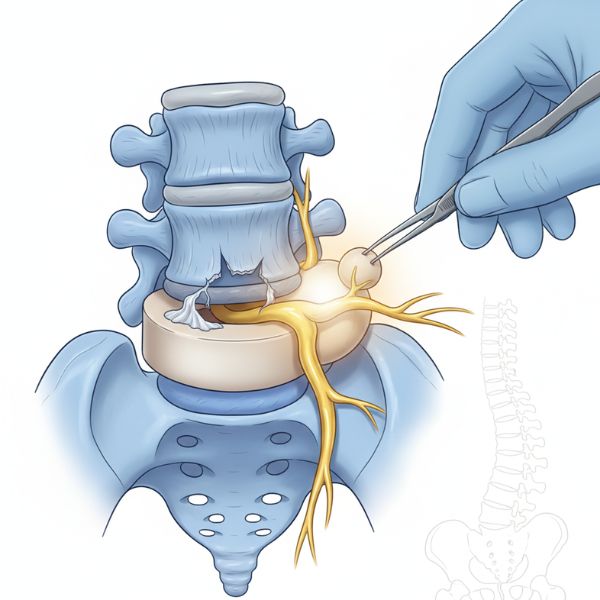
What is a Lumbar Discectomy?
At its core, a lumbar discectomy is a type of lumbar spine surgery designed to relieve pressure on a spinal nerve. In your lower back (the lumbar region), you have discs that act as cushions between your vertebrae. When a disc herniates or “slips,” a piece of its soft center (the nucleus pulposus) can bulge out and press on a nearby nerve root.

The Main Goal: Relieving Leg Pain (Sciatica)
This is the most important takeaway. The primary candidate for this surgery isn’t someone with just lower back pain. The true purpose of a discectomy is to relieve radicular pain—the sharp, burning, or pins-and-needles pain that shoots down your leg. This is because the procedure directly targets the nerve being compressed, which is the source of the leg pain. While it can help associated back pain, the most dramatic and predictable improvement is almost always in the leg pain.

When Conservative Treatments Have Failed
Surgery is almost never the first step. As your Austin orthopedic surgeon, we will always explore non-surgical options first. A lumbar discectomy is typically recommended only after you’ve diligently tried several months of conservative lumbar treatment. This includes physical therapy, anti-inflammatory medications, and potentially epidural steroid injections.

Addressing Serious Neurological Symptoms
This surgery isn’t just about pain. If that compressed nerve is causing progressive neurological deficits, it’s a clear sign for intervention. This includes symptoms like:
- Significant numbness in your leg or foot
- Progressive weakness, such as a “foot drop” (difficulty lifting the front of your foot)
- Loss of reflexes
In these cases, your spine surgeon may recommend the procedure more promptly to decompress the nerve, give it the best chance to heal, and prevent permanent nerve damage.

The Minimally Invasive Approach (Microdiscectomy)
When you hear “spine surgery,” you might imagine a long, difficult recovery. However, the best back surgeons in Texas today perform this procedure using minimally invasive techniques. This is often called a microdiscectomy. Using a special microscope and small, specialized instruments, your spine specialist can perform the entire surgery through a very small incision (often just an inch).

High Success Rate and Patient Satisfaction
One of the main reasons we recommend this procedure is its high success rate. For the right candidate, a lumbar discectomy provides significant, often immediate, relief from leg pain. It is one of the most common and reliable procedures a spine surgeon performs. Patients are frequently thrilled to wake up from surgery and find that the sharp leg pain they’ve lived with for months is finally gone, allowing them to return to the activities they love. This is why it’s such a valuable and trusted type of lumbar spine surgery.
SCHEDULE A CONSULTATION
Living with sciatica doesn’t have to be your reality. If you’re in the Austin area and this sounds like your story, it’s time to consult a true specialist. The team at Central Texas Spine Institute includes some of the best back surgeons in Texas. As a premier Austin orthopedic surgeon practice, our goal is to provide a precise diagnosis and the least invasive, most effective treatment plan for you. Don’t just live with the pain; contact our local back doctor at CTSI today and take the first step toward getting your life back.
